
Crusades

visible are arteries and nerves
Even if the "dark"' Middle Ages in Christian Europe was not as backward as often claimed, the high culture of Islamic countries was amazing.
- writings, knowledge from ancient times
- trade with Africa, India, China
- promotion of science and art
- tolerance towards "book believers"
provided for a rich culture, which was often adopted by the crusaders.
Cultural Exchange
The crusaders encountered many things in the Orient that they did not yet know. Often they did not invent their own words for new things, but adopted the already existing Arabic word. Many terms show the influence of Arabic on the English language:
| ORANGE برتقال |
 |
fruit, originally from South and East Asia, known in Sanskrit as naranga, which became the Arabic naranj. |
| ALCOHOL (الكُحُـــــــــول.) |
 |
an extraction process from a mineral, European chemists began to refer to anything involving extraction/distillation as alcohol. |
| ALCHEMY & CHEMISTRY (الكيميـــــــــاء.) |
 |
put together |
| ALGEBRA (الجبــر) |
 |
a mathematical discipline |
| CANDY (from قندي) |
 |
“hard sweets made by boiling cane sugar” |
| COFFEE (قهوة) |
 |
for long snubbed by Europeans as the “wine of the infidels”—that is, many centuries before the age of Starbucks and instant coffee! |
part 2
| SOFA (الصُفــــــــة) |
 |
cushioned item of furniture for seating multiple people |
raised, carpeted platform on which people sat. |
| SUGAR (سكر) |
 |
Sanskrit (śarkarā), meaning "ground or candied sugar" | |
| CIPHER (صِفـــــــــــــــــــــــــــر) |
 |
Arabic word for zero صفر (sifr) | not easily understood, so used for encrypted code |
| ELIXIR (الإكسيــــــــــــــر) |
 |
like a syrup | |
| SODA (صـــــــــودا.) |
 |
chemical compounds containing sodium | |
| ARTICHOKE |  |
variety of a species of thistle cultivated as food. |
part 3
| ADMIRAL (أميــــــــر الرحلة) |
 |
commander of the fleet |
| ARSENAL ( دار الصناعــــــــــــــــة ) |
 |
manufacturing house where weapons for the navy are made |
| MAGAZINE ( مجلة) |
 |
store house |
| ASSASSIN (حشَّــــــــــــــاشين”) |
 |
hitman, murderer |
| COTTON (قُطْـــــــــن) |
.jpg) |
soft, fluffy staple fiber used for textiles |
| MATTRESS (مطـــــــــــــــــــرح.) |
 |
large, usually rectangular pad where you can lie and sleep |
Arabic, Latin or Greek?
Some words originated in Greek, were translated into Arabic and found their way into the English language:
Sort the loan words after their original language:
| Arabic | guitar | alcohol | cipher | algebra | safran | tariff | tambourine | artichoke | safari |
| Greek | philosophy | tragedy | Maths | democracy | monologue | ||||
| Latin | cherry | wine | process | jurist | peach | chamber | street |
Sort the following Arabic loan words after topics:
| Spice / Fruit Beverages |
coffee | alcohol | lemonade | safran | muskat | orange | sugar | peach |
| Textiles | cotton | damast | jacket | German: Kittel | German: Mütze | |||
| Furniture | mattress | sofa | mosaik | diwan | baldachin | |||
| Music | lute (German: Laute) |
guitar | tambourine | fanfare trumpet | ||||
| Science | cipher | algebra | elixir | azure | algorithm | risk |
counting and calculating
The merchant and mathematician Leonardo Fibonacci from Pisa triggered a mathematical revolution with his book "Liber abaci". He noticed:
The nine numbers of the Indians are: 9 8 7 6 5 4 3 2 I.
With them and with the sign 0, which is called "sifr" in Arabic,you can write every number you want.
- Where do the "Arabic" numbers really come from?
- How do you pronounce 0 in English? Do you know which original language it's from?
- Compare the addition tasks below with each other and then fill in the missing words in the following text.
Roman Numerals
MM
+ XVIII
_____________________
MMXVIII
=================
Arabic Numerals
2000
+ 18
_____________________
2018
=================
The numerical values are the same in both tasks. There are two advantages to written arithmetic with Arabic numerals:
With the Roman numerals, there is no numeral sign for the numerical value zero.
In the spoken form, Roman numerals, like Arabic numerals, are structured according to the ten system. In the written form, however, the Roman numerals lack the division into "ones", "tens", "hundreds", "twos" and "threes". hundreds, etc.
fun stuff
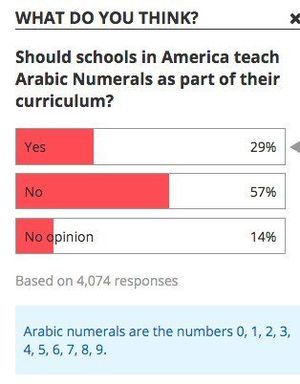
I can't believe this:
Vocabulary
crusader = Kreuzzügler, Kreuzritter
crusade = Kreuzzug
crusade = religious war to free the Holy Land (= Jerusalem, Palestine)
Why - because pilgrims wanted to visit the place where Jesus had lived.